
Navanethem “Navi” Pillay stands as one of South Africa’s most distinguished jurists and human rights defenders. Born on 23 September 1941 in Clairwood, Durban, under the shadow of apartheid, she rose from a working-class Tamil family of Indian descent to become a pioneering lawyer, judge, United Nations High Commissioner for Human Rights, and, in 2026, a Nobel Peace Prize laureate recognised for her efforts to promote peace and international law.

Early Life and Education
Pillay grew up as the fifth of eight children in a modest household. Her father, Narrainsamy Naidoo, worked as a bus driver and took on extra jobs such as fishing to support the family. Her mother, Santhama, managed the home. The family’s roots traced back to Indian indentured labourers who had arrived in Natal in the late 19th century to work on sugar plantations. Education was valued despite limited means and the severe restrictions of apartheid, which formalised racial segregation shortly after her birth.
Local community support proved decisive. Residents of Clairwood contributed funds so that the academically gifted young woman could attend university. She earned a Bachelor of Arts in 1963 and a Bachelor of Laws in 1965 from the University of Natal (now the University of KwaZulu-Natal). At university she joined the Non-European Unity Movement. Later she pursued advanced studies at Harvard Law School, obtaining a Master of Laws in 1982 and a Doctor of Juridical Science in 1988 - the first South African to receive a law doctorate from the institution.
In 1965 she married Gaby Pillay, also a lawyer. The couple later adopted two daughters.
Breaking Barriers Under Apartheid
No established law firm would employ her. Firms cited the impossibility of white staff taking instructions from a person of colour. In 1967, at the age of 26, Pillay opened her own practice - the first woman-owned law practice in Natal. She operated under the severe constraints of apartheid: she was barred from judges’ chambers and from whites-only legal libraries.
For nearly three decades Navi Pillay defended anti-apartheid activists across political organisations. One of her early cases involved representing Phyllis Naidoo, charged for failing to report to police as a banned person. In 1973 she secured a landmark ruling that granted political prisoners on Robben Island (including Nelson Mandela) the right to access lawyers and legal materials. She also represented Black Consciousness Movement activists and challenged torture and harsh detention conditions. Her work combined courtroom advocacy with teaching at the University of Natal and community initiatives, including co-founding the Advice Desk for Abused Women and, later, the international organisation Equality Now.
Judicial Appointments and International Criminal Law
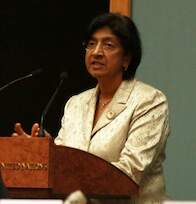
After South Africa’s first democratic elections in 1994, President Nelson Mandela appointed Pillay an acting judge of the High Court in 1995. She became the first non-white woman to serve on the court.
That same year the United Nations General Assembly elected her a judge of the International Criminal Tribunal for Rwanda (ICTR), established to prosecute those responsible for the 1994 genocide.
She served eight years, the last four (1999–2003) as President, and was the only woman judge for the tribunal’s first four years. Her most enduring contribution came in the landmark Akayesu case.
The judgment established that rape and sexual violence could constitute acts of genocide when committed with the intent to destroy a protected group. It also advanced jurisprudence on hate propaganda and freedom of speech in the context of incitement to genocide. These rulings fundamentally shaped international criminal law on sexual violence in conflict.
From 2003 to 2008 Pillay served as a judge on the Appeals Division of the International Criminal Court in The Hague.
United Nations High Commissioner for Human Rights
In 2008 UN Secretary-General Ban Ki-moon nominated her as High Commissioner for Human Rights. Confirmed by the General Assembly, she held the post from 2008 to 2014. She described the role as being “the voice of the victim everywhere.”
During her tenure she advocated for accountability in conflicts including those in Syria, Sri Lanka and Gaza, pressed for action against caste discrimination, supported recognition of the rights of lesbian, gay, bisexual and transgender people, and worked to strengthen the Office’s independence and engagement with the Security Council and civil society.
Later Work and the Nobel Peace Prize
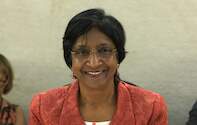
Navi Pillay continued to serve international justice mechanisms. She chaired the UN Independent International Commission of Inquiry on the Occupied Palestinian Territory from 2021 until late 2025 and has served as an ad hoc judge of the International Court of Justice in proceedings concerning alleged genocide in Myanmar.
On 9 October 2026 the Norwegian Nobel Committee awarded Navi Pillay the Nobel Peace Prize “for her efforts to promote peace and international law.”
The Committee highlighted her instrumental role in ensuring that war crimes, crimes against humanity and genocide are prosecuted, and praised her judicial rigour, personal integrity and courage at a time when international legal institutions face political pressure.